Analysis
Beyond EV Adoption: Industrial Policy, Carbon Finance and Thailand’s Automotive Transition
How policy-mediated technological change is reshaping industrial competitiveness, domestic value creation and verifiable decarbonisation.
Executive Summary
Thailand’s rapid expansion of electric mobility shows how the energy transition can reshape industrial competitiveness, investment and production. The shift is not driven by technology or consumer choice alone: subsidies, production obligations, infrastructure, finance and carbon-market mechanisms influence which technologies scale, where production is located and how risks and gains are distributed. Thailand has accelerated EV adoption and attracted investment, but the next phase must convert market formation into durable domestic capability and verifiable public value.
Success should therefore not be measured by vehicle sales, factory announcements or approved investment alone. It should be assessed by domestic value added, supplier upgrading, technological capability, skilled employment, fiscal efficiency, consumer protection, air-quality improvement and verified emissions reductions. Thailand now needs a second-generation policy framework that preserves investment momentum while managing affordability, commercial risk, infrastructure, battery circularity and adjustment costs.
This analysis treats Thailand as a policy-mediated industrial transition rather than a straightforward case of technological substitution. It examines five interrelated dimensions: market adoption, domestic production, technological capability, environmental performance, and the distribution of gains and adjustment costs. The Bangkok e-bus programme illustrates how high-use fleets can combine operating savings, public value and carbon finance, while also requiring credible monitoring, corresponding adjustments and transparent allocation of carbon revenue.
Key messages
| 1 | Thailand’s EV transition is an industrial realignment that changes which capabilities, assets and institutions create value. |
| 2 | The next policy phase should tie support to measurable outcomes while managing affordability, infrastructure, commercial and fiscal risks. |
| 3 | Domestic value depends on local sourcing, supplier upgrading, skilled employment, research, software, battery capability and intellectual property—not assembly alone. |
| 4 | Climate performance requires verified lifecycle emissions reductions, cleaner electricity, air-quality benefits and battery circularity—not zero tailpipe emissions alone. |
| 5 | High-use fleets can combine operating savings, public value and carbon finance, but require credible monitoring, clear carbon ownership and fair revenue sharing. |
1. Thailand’s changing automotive landscape
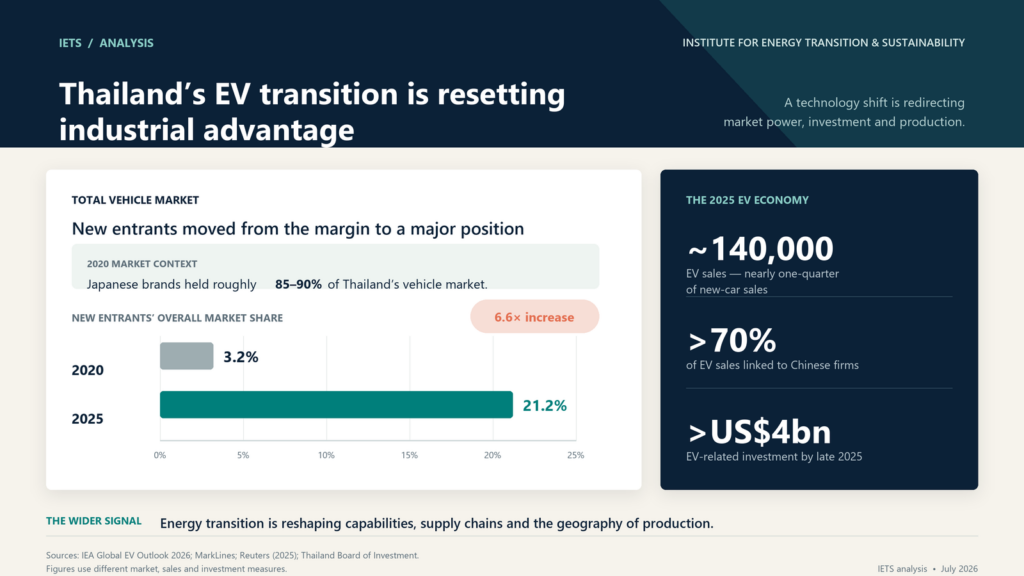
For decades, Thailand represented one of the most successful examples of Japanese industrial expansion overseas. Toyota, Honda, Isuzu, Mitsubishi and Nissan established extensive manufacturing operations, supplier networks and distribution systems in the country. Japanese brands dominated domestic vehicle sales—accounting for roughly 85–90 per cent of the market as recently as 2020—while Thailand developed into Southeast Asia’s leading automotive production and export centre—the “Detroit of Asia”.
Electric vehicles are now disrupting this established industrial order.
The shift has been rapid. Less than a decade ago, electric cars were commercially marginal in Thailand. By 2025, sales of electric cars—battery-electric and plug-in hybrid vehicles in the IEA definition—had risen by approximately 70 per cent to around 140,000 vehicles, representing nearly one-quarter of all new-car sales. Thailand became the second-largest electric-car market in Southeast Asia, according to the International Energy Agency’s Global EV Outlook 2026.
Chinese-owned brands have expanded quickly, alongside other post-2020 market entrants. Chinese automakers’ share of Thailand’s overall vehicle market increased from approximately 3.2 per cent in 2020 to 21.2 per cent in 2025, while Chinese-owned brands accounted for more than 70 per cent of battery-electric-car sales, according to MarkLines and Reuters.
This expansion has been accompanied by a broader shift in consumer expectations. Buyers increasingly compare battery range, charging speed, digital interfaces, driver-assistance functions and in-car technology—not only engine reliability, fuel consumption, brand history and resale value.
Japanese manufacturers nevertheless remain the largest overall force in Thailand’s automotive market and production base. They retain considerable advantages in pickup trucks, conventional vehicles, hybrid technologies, local manufacturing, distribution, servicing and consumer trust. The current transformation should therefore not be interpreted as a simple replacement of one group of manufacturers by another.
Instead, the market is becoming segmented by technology. Established manufacturers remain strong in internal-combustion vehicles and non-plug-in hybrids, while newer entrants have gained ground in battery-electric vehicles and are expanding into other electrified platforms. Thailand is moving from a relatively concentrated automotive system towards a more diversified and technologically differentiated market.
2. Technological change and industrial realignment
The Thai case demonstrates that industrial leadership is closely connected to the prevailing technological paradigm.
Japan’s automotive strength was built on world-class capabilities in internal-combustion engines, transmissions, mechanical reliability, lean production, supplier coordination and continuous product improvement. These capabilities supported its dominance in Thailand for decades.
Battery-electric vehicles depend on a different combination of assets. Their competitiveness is increasingly shaped by batteries, electric motors, power electronics, semiconductors, software, digital interfaces, charging infrastructure and energy-management technologies. Mechanical complexity declines, while electrochemistry, electronics and software become more important.
Established manufacturers do not lose all their advantages. Production quality, safety engineering, distribution networks, financing, servicing and brand reputation remain critical. Technological change does, however, alter the relative economic value of different capabilities.
A technological paradigm shift does not merely introduce new products. It changes which capabilities, assets and institutions create economic value.
The Thai case also shows that a technological paradigm shift is mediated by public policy. Incentives influence which technologies scale, where factories are located, how quickly firms commit capital and who carries the risk of early market development. Policy therefore does more than accelerate a transition that would otherwise occur independently; it shapes the industrial structure emerging from that transition.
This distinction is important for evaluating domestic value creation. Vehicle assembly, battery-module production, battery-cell production, power electronics, software, research and development, and ownership of intellectual property represent different levels of technological depth. Counting factories or announced investment without examining these functions can overstate industrial upgrading.
Globally, electric-car sales exceeded 20 million in 2025, accounting for one-quarter of all new cars sold, according to the International Energy Agency. The rapid scaling of EV technologies has been supported by integrated industrial ecosystems that combine battery production, electronics, component supply and vehicle assembly.
New entrants have leveraged these emerging ecosystems to compete effectively in EV markets without first surpassing incumbents in conventional automotive technologies. This helps explain why an established market structure can change rapidly once the underlying technology shifts. Assets that are highly productive under one technological system may require expensive conversion—or lose part of their value—under another.
For incumbent manufacturers, Thailand’s extensive combustion-engine ecosystem remains an important source of competitiveness. At the same time, it makes rapid transformation more complicated. A faster shift towards battery-electric vehicles could disrupt existing factories, suppliers and employment; a slower shift could surrender emerging market segments to competitors.
The energy transition therefore creates a strategic tension between exploiting existing advantages and building capabilities for the next industrial system.
Implications for the global economy
In the fossil-fuel economy, competitive advantage was often associated with access to oil and gas, refining capacity, combustion technologies and established heavy-industrial systems.
In an increasingly electrified economy, advantage may depend more heavily on low-cost clean electricity, batteries, critical-mineral processing, power electronics, digital technologies, grids and advanced manufacturing.
The same pattern is emerging beyond transport. Solar manufacturing is restructuring power-sector supply chains. Battery storage is changing electricity-market operations. Grid technologies are becoming increasingly strategic. Green hydrogen and low-carbon production processes could affect the future location of steel, fertiliser, chemicals, shipping and other emissions-intensive industries.
Energy transition is therefore not simply the substitution of clean technologies for fossil-fuel technologies. It is a restructuring of industrial systems, value chains and international economic relationships.
These changes will not distribute benefits and costs evenly.
Consumers may benefit from lower prices, improved products and wider choice. New manufacturers and suppliers may gain access to investment and markets. Countries attracting production may obtain employment, exports and tax revenue.
At the same time, traditional suppliers may lose demand. Workers specialising in engines, transmissions and conventional components may face displacement. Governments may bear substantial subsidy and infrastructure costs. Rapid expansion can create excess capacity, destructive price competition and risks for consumers when weaker manufacturers or distributors fail.
Thailand has already experienced some of these tensions. Strong competition and aggressive discounting have placed pressure on manufacturers and dealers, while the financial difficulties of some EV companies have raised concerns about servicing, spare parts and consumer protection. In the EV segment, firms linked to China currently hold a dominant position, but market share alone does not guarantee long-term commercial sustainability, as discussed by Reuters.
The transition can increase aggregate economic opportunities while producing concentrated losses. Industrial transformation and just transition must therefore be analysed together.
3. How policy and finance are shaping the transition
Thailand’s automotive transformation is not simply a case of changing vehicle sales. It demonstrates how the energy transition can reshape the geography of manufacturing and investment.
Thailand has treated EV adoption as both an environmental objective and an industrial-development strategy. The EV 3.5 package covers 2024-2027 and combines time-limited purchase subsidies, excise-tax reductions, earlier import-duty relief and domestic-production obligations. For passenger BEVs priced below THB 2 million, the 2026-2027 subsidy is THB 25,000 for batteries below 50 kWh and THB 50,000 for batteries of at least 50 kWh. The excise-tax rate for qualifying electric passenger cars is reduced from 8 per cent to 2 per cent. Import-duty reductions of up to 40 per cent applied to qualifying completely built-up vehicles imported in 2024-2025. Participating manufacturers were required to compensate those imports through domestic production at a ratio of 1:2 by 2026 or 1:3 by 2027, as set out in Thailand’s EV 3.5 measures.
The intention is to convert market demand into domestic manufacturing capability rather than allowing public incentives to support imports alone.
A layered incentive architecture
Consumer support is only one layer of the policy. Supply-side incentives administered through the Board of Investment include corporate-income-tax exemptions, exemptions from import duties on machinery and selected materials, and support for vehicle assembly, batteries, key components, charging stations and battery-swapping facilities. By mid-2025, BOI reported THB 137.7 billion in cumulative investment across the domestic EV supply chain, including vehicle production, battery activity, components and charging infrastructure. The industrial effect of this investment nevertheless depends on whether Thailand captures higher-value functions rather than assembly alone.
A second layer targeted commercial fleets. Companies and juristic partnerships purchasing domestically manufactured electric buses or trucks were permitted to deduct expenditure equal to twice the actual vehicle price for corporate-income-tax purposes, compared with 1.5 times the price for qualifying imported vehicles. The measure, which ran through the end of 2025, had no maximum vehicle-price ceiling and was intended to stimulate at least 10,000 large commercial EVs. It extended policy attention beyond passenger cars to vehicles with high annual mileage and correspondingly large potential fuel, pollution and emissions savings.
A third layer is finance. The transition is shaped not only by the sticker price of a vehicle but also by loan approval, interest rates, residual-value assumptions, battery warranties, charging investment and the allocation of operating risk. These factors are especially important for taxis, buses, trucks and motorcycle taxis, where users may benefit from lower operating costs but lack the balance-sheet capacity to absorb the initial investment.
Policy design has continued to change in response to market conditions. In 2025, the EV Board allowed one exported EV to count as 1.5 vehicles toward a manufacturer’s local-production obligation, seeking to encourage exports and reduce domestic oversupply. In July 2026, the government was also considering, but had not yet approved, a THB 24 billion programme to replace up to 80,000 ageing taxis, motorcycle taxis, tuk-tuks, buses and trucks with electric alternatives through a possible combination of grants, concessional finance and tax measures. The proposal illustrates a shift toward high-use commercial vehicles, but it should not be described as an enacted incentive until final approval and operating rules are issued.
Manufacturers have responded with significant investment in assembly and production facilities. By early 2025, Chinese EV producers had committed more than US$3 billion to Thai facilities, while BOI’s broader accounting of the EV supply chain reached THB 137.7 billion, approximately US$4.2 billion, by the end of June 2025. These figures use different scopes and should not be treated as directly interchangeable: the first concerns a group of vehicle producers, whereas the second includes batteries, parts and charging infrastructure.
These adjustments illustrate why industrial policy must evolve as market conditions change. Incentives that successfully attract investment can later contribute to excess capacity, price competition and fiscal exposure if production expands more quickly than sustainable demand.
Thailand is nevertheless attempting to preserve its position as an automotive production centre while the industry’s underlying technology changes. Its future role may no longer be defined only as a combustion-vehicle production base. It could become a more diversified regional EV hub involving multiple international manufacturers.
The implications extend beyond Thailand. As EV producers expand overseas, their internationalisation is shifting from exports alone towards local production, regional supply chains and cross-border investment. This can redirect the location of vehicle assembly, battery systems, component procurement, logistics, skills development and export infrastructure.
The energy transition is therefore reshaping competition not only among companies, but also among countries seeking to attract and retain low-carbon industries.
4. From market growth to domestic and environmental value
Domestic industrial value
The relevant policy question is therefore not whether EV investment is present, but what kinds of domestic capability it creates. Local production does not automatically generate deep industrial development. Its contribution depends on the degree of local sourcing, technology transfer, supplier participation, workforce development and research capability. A country may host assembly plants while capturing only a limited share of technological and economic value.
Evaluation should distinguish among assembly scale; local sourcing and supplier participation; battery, power-electronics and software capability; research, design and intellectual property; and skilled employment and regional distribution. Reporting these outcomes separately would prevent factory counts or headline investment values from being mistaken for technological upgrading.
For Thailand, the practical challenge is to convert established capabilities in machining, metal parts, quality control, logistics and supplier coordination into assets for electric platforms. This requires targeted supplier diagnostics, standards and testing support, workforce retraining, collaborative research and access to upgrading finance. Some combustion-specific activities will nevertheless contract, making adjustment support and regional employment monitoring essential.
From adoption to verifiable decarbonisation
Sales, registrations and factory investment are indicators of market and industrial change, not direct measures of climate performance. Battery-electric vehicles eliminate tailpipe emissions, but their system-wide greenhouse-gas effect depends on electricity generation, charging losses, annual kilometres travelled, the vehicle displaced, battery production and end-of-life management. The emissions benefit is generally larger for intensively used vehicles and where charging is supplied by progressively cleaner electricity.
This makes public and commercial fleets strategically important. A private passenger car may travel relatively few kilometres each year, whereas an urban bus, taxi, delivery vehicle or motorcycle taxi operates for long hours and replaces much more fossil-fuel consumption. Electrifying high-use fleets can therefore produce larger emissions and air-quality benefits per vehicle, while centralized depots and digital fleet systems make electricity consumption and distance travelled easier to monitor.
Charging, grids and infrastructure
Thailand had nearly 12,000 public chargers by the end of 2025, with fast chargers representing about 60 per cent of the stock. Aggregate charger numbers, however, conceal unequal geographical access, condominium and rental-housing constraints, queueing, interoperability and the different requirements of cars, motorcycles, buses and heavy trucks. Large fleets require depot land, grid connections, transformers, managed charging and reliable schedules. Grid planning and renewable-electricity procurement therefore form part of transport policy rather than a separate energy-sector issue.
Battery circularity and environmental integrity
The policy framework remains incomplete if it accelerates battery deployment without establishing responsibility for collection, diagnostics, second-life use, recycling and safe disposal. Battery passports, state-of-health standards, producer responsibility and traceable material flows can protect consumers and support a domestic circular-economy industry. These measures are also necessary to prevent the environmental burden of the transition from being shifted from urban tailpipes to electricity generation, mineral supply chains or unmanaged battery waste.
5. Bangkok e-buses: connecting electrification and carbon finance
The Bangkok E-Bus Programme demonstrates how fleet electrification can be connected to carbon finance. Owned by Energy Absolute and implemented with private bus operators in the Bangkok Metropolitan Area, it became the first mitigation programme in Asia authorized under Article 6.2 of the Paris Agreement. The programme combines replacement of combustion buses, investment in charging infrastructure and the monitored operation of electric public transport.
By April 2026, more than 2,000 electric buses deployed during 2023-2024 had generated 49,717 Internationally Transferred Mitigation Outcomes in the Swiss emissions-trading registry. The KliK Foundation states that its purchase of the resulting mitigation outcomes helped make the fleet conversion financially viable by narrowing the capital-cost gap between combustion and electric buses. This represents a fourth layer of incentive: performance-based revenue paid only after monitored reductions have been validated, verified and authorized.
Thai T-VER records provide a separate project-level view. Bangkok Metropolitan Area E-Bus Zones 1 and 2 is registered with expected reductions of 33,441 tCO2e per year. T-VER issuance reached 11,321 tCO2e for the 2024 monitoring period and 23,698 tCO2e for 2025, bringing cumulative issuance since 2022 to 48,316 tCO2e. The project applies a T-VER methodology for public-transport use. These domestic project-level figures and the programme-wide ITMO total have different scopes, accounting rules and monitoring periods and should not be compared as if they measured the same activity.
The case also exposes governance questions that a vehicle-sales analysis cannot answer. Thailand applies a corresponding adjustment for mitigation outcomes transferred to Switzerland, preventing Thailand and Switzerland from claiming the same emissions reduction toward their respective national targets. Two per cent of the issued outcomes are cancelled for overall mitigation in global emissions. Carbon finance can therefore accelerate investment, but transferred reductions also have an opportunity cost for the host country’s own NDC accounting.
Carbon credits are not automatically appropriate for every EV. Credible crediting requires additionality, a defensible combustion-vehicle baseline, reliable records of distance and electricity use, an applicable grid-emission factor, independent verification, safeguards and clear ownership of the carbon asset. Programme-level fleets are more suitable than dispersed private cars because monitoring costs can be spread across many vehicles. Future evaluation should also examine how carbon revenue is distributed among the project developer, vehicle owner, operator, financier and passengers.
6. Risks, policy priorities and questions for stakeholders
Thailand now needs to move from rapid market formation to a second-generation policy framework that manages affordability, industrial depth, infrastructure, consumer protection and environmental integrity together. The central task is to preserve investment momentum while reducing fiscal, commercial and distributional risks.
Affordability, credit and residual-value risk
Thailand’s automotive slowdown cannot be understood from vehicle prices alone. The Bank of Thailand has identified weak purchasing power, high household debt, cautious hire-purchase lending, declining second-hand vehicle prices and the EV price war as interacting constraints. Aggressive discounting can improve short-term affordability, but it may also cause buyers to delay purchases, weaken residual values and increase losses for lenders when repossessed vehicles are sold. For commercial drivers and small fleet operators, a lower lifetime operating cost is insufficient if financing for the initial purchase cannot be obtained.
Consumer protection and commercial resilience
Rapid entry and price competition have expanded choice but also created risks involving distributor failure, warranty continuity, spare-parts availability, repair capability and software support. Consumer confidence depends on long-term service networks and transparent battery-health information, not only the initial purchase price. Regulators may need minimum obligations for parts, warranties, data access and orderly market exit, especially where public incentives have accelerated entry.
Supplier upgrading, employment and regional concentration
Thailand’s existing automotive ecosystem contains extensive capabilities in engines, transmissions, machining, metal parts and supplier coordination. Some of these capabilities can be redirected toward electric platforms; others may experience structural decline. A just industrial transition requires supplier diagnostics, concessional upgrading finance, standards support, workforce retraining and stronger links between foreign investors, Thai firms, universities and research institutions. It also requires attention to whether new investment generates high-quality local employment or concentrates gains in a limited number of firms and regions.
Policy calibration and fiscal discipline
Production obligations successfully induced local investment, but they also created a risk that output would rise faster than credit-constrained domestic demand. Export multipliers and timetable adjustments reduced immediate pressure, yet repeated rule changes can weaken predictability. Future support should be assessed against explicit performance indicators: verified emissions reduction, domestic value added, supplier participation, skilled employment, research capability, export performance, fiscal cost per outcome and the distribution of benefits across income groups.
Policy priorities for the next phase
- Tie incentives to outcomes. Future support should be conditional on measurable domestic value added, supplier upgrading, skilled employment, fiscal efficiency, air-quality improvement and verified emissions reductions—not sales or investment announcements alone.
- Prioritise high-use fleets. Direct concessional finance, charging and grid support towards buses, taxis, delivery fleets, motorcycle taxis and trucks where utilisation is high and operating savings can support repayment.
- Build capability and commercial resilience. Pair investment promotion with supplier-development programmes, standards and testing infrastructure, workforce transition, research partnerships and enforceable consumer-service obligations.
- Govern batteries and carbon assets. Establish battery-health disclosure, producer responsibility, recycling and traceability, while allowing carbon finance only where additionality, monitoring, corresponding adjustments, ownership and revenue-sharing are clear.
Questions for governments and regulators
Governments need to determine whether their industrial policies remain appropriate when established technological advantages begin to erode.
Which incumbent industries should be supported through conversion rather than indefinite protection? Which parts of emerging low-carbon value chains can realistically be localised? How should consumer incentives be connected with manufacturing, innovation, skills and domestic value creation?
Governments must also assess how energy, industrial, trade, infrastructure, competition and education policies interact. Supporting EV adoption without adequate electricity supply, charging infrastructure, workforce capabilities or competitive markets may generate limited economic and environmental benefits.
The objective should not simply be to increase the number of electric vehicles. It should be to use the transition to accelerate low-carbon development while strengthening productive capability and economic resilience.
Policy evaluation should therefore distinguish inputs from outcomes. Subsidy expenditure, investment approvals and charging-station counts are inputs; additional domestic value, resilient firms, accessible mobility, improved air quality and verified emissions reductions are outcomes. Publishing both sets of indicators would make the distribution and effectiveness of support more transparent.
Questions for manufacturers, suppliers, fleet operators and financiers
Incumbent companies need to identify which existing capabilities will retain strategic value and which assets could become liabilities.
Which factories and supplier relationships can be adapted? Which technologies should be developed internally, acquired or accessed through partnerships? How quickly can companies transform without undermining current revenues, employment and supplier networks?
Emerging companies face a different challenge. Rapid sales growth does not guarantee durable competitiveness. They need reliable servicing, spare-parts availability, financing, residual values, local supplier relationships and long-term consumer trust.
The strategic objective should not merely be to become larger. It should be to build technologically capable, financially resilient and internationally competitive enterprises.
Fleet operators and financiers should additionally evaluate vehicles on a total-cost-of-ownership basis that includes charging infrastructure, route utilization, battery degradation, residual value, downtime and carbon revenue. Carbon credits should be treated as conditional performance revenue rather than a substitute for a viable operating model.
Questions for researchers and civil-society organisations
The domestic and international distributional consequences of the transition require much greater attention.
Who benefits from new investment? Which firms, workers and regions bear the adjustment costs? How are subsidies distributed among manufacturers, consumers and taxpayers? Do new factories create high-quality local employment and technological capability, or primarily assemble imported components?
There are also international distributional questions. Countries controlling technologies, intellectual property, finance and supply chains may capture much of the value created by the transition. Countries primarily importing low-carbon technologies may reduce emissions while developing new trade or technological dependencies.
Critical-mineral-producing countries may attract investment, but affected communities may bear substantial environmental and social costs. A just transition therefore requires analysis of how income, employment, ownership, risks and decision-making power are distributed both within and between countries.
Research should also examine whether public and carbon-market support reaches the actors facing the greatest transition constraints. This includes Thai component suppliers, indebted households, motorcycle-taxi and taxi drivers, small logistics businesses, bus passengers and workers whose skills are tied to combustion technologies. The equity question is not only who purchases an EV, but who receives cleaner mobility, lower operating costs, employment opportunities and decision-making power.
Suggested citation and disclaimer
Shi, Xunpeng and Nophea Sasaki (July 2026), “Beyond EV Adoption: Industrial Policy, Carbon Finance and Thailand’s Automotive Transition”, IETS Policy Analysis, Sydney: Institute for Energy Transition & Sustainability.
The views expressed are those of the authors and do not necessarily represent the views of IETS or any partner organisation. Policy status and data are current to 28 July 2026.
| How IETS can support stakeholders
IETS works with governments, development partners, civil-society organisations, investors and enterprises on the policy, market, financial, technological and social dimensions of energy transition and sustainable development. Its services include policy and market analysis, industrial and corporate strategy, programme and project development, carbon-finance and emissions-integrity assessment, stakeholder consultation, and just-transition analysis. IETS also provides market-preparation and market-entry analysis for investors, including regulatory and incentive mapping, sector and supply-chain assessment, partner and stakeholder identification, investment-readiness evaluation and risk analysis. For organisations preparing cross-border investment, IETS offers customised training and executive briefings tailored to particular countries, technologies and investment models. Topics can include policy and regulatory environments, market structures, local business practices, stakeholder engagement, carbon-market considerations, sustainability requirements and implementation risks. Organisations interested in commissioning research, preparing for market entry, developing joint projects or arranging customised training are invited to contact info@iets.cc or visit iets.cc. |
Download the report at: IETS_Policy_Analysis_Thailand_EV_Published
Contributors

Xunpeng (Roc) Shi
Contributor

Nophea (Noppy) Sasaki
Contributor
Research Areas: Business Development, Partnerships and Strategy, Economics, Markets and Finance
Topics: Battery Value Chains, Supply chains
Regions: China, Global, Southeast Asia