
分析
AI’s Power Challenge: Australia’s Coal Paradox and the Case for Smarter Data Centre Growth
Australia’s AI ambitions are testing an electricity system already undergoing profound change. Coordinating computing investment with energy supply will determine whether data centres accelerate the transition or deepen dependence on ageing infrastructure.
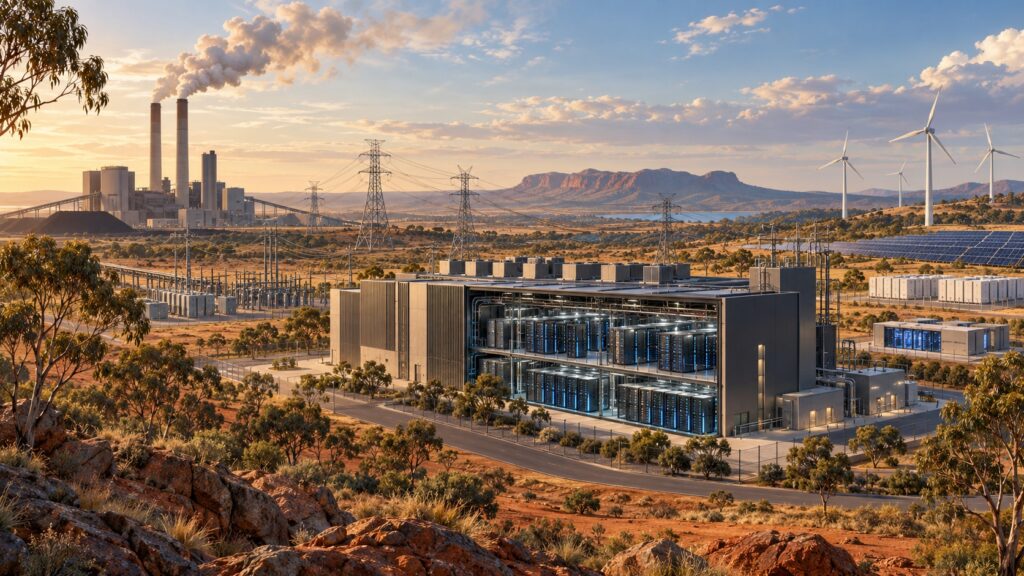
A proposed A$32 billion data centre development in Queensland has brought an old energy debate back into focus. Nationals MP David Littleproud has called for a new coal-fired power station, comparable to the existing 750 MW Kogan Creek facility, to help supply the project. Anthropic has agreed to use part of the proposed development, which remains subject to planning approval. The call for new coal is a political proposal, rather than a confirmed supply arrangement. [1]
The debate exposes a striking paradox. Australia has built no new coal-fired power stations since Bluewaters commenced operations in Western Australia in 2009. Yet governments have intervened to support the continued operation of existing plants. Eraring’s planned closure moved from 2025 to 2027 under a 2024 agreement with the New South Wales government; Origin subsequently extended operations to April 2029. Now, expanding AI demand is bringing new coal construction back into public discussion. [2–4]
This juxtaposition reveals the pressure on Australia’s energy transition. Coal is expected to leave the system, but replacement infrastructure must be ready when and where it is needed. A rapidly expanding digital sector adds urgency to that coordination challenge.
The scale of potential demand is substantial. In its 2026 Electricity Statement of Opportunities, the Australian Energy Market Operator (AEMO) projects data centre electricity consumption in the National Electricity Market (NEM) to increase from around 5 TWh in 2025–26 to 15 TWh in 2029–30 and 34 TWh in 2035–36 under its Step Change scenario. The latter represents approximately 13% of projected NEM operational consumption. These figures cover all data centre activity, including AI, across eastern and south-eastern Australia. [5]
The immediate constraint is often local. A country can possess abundant energy resources while a particular network connection cannot accommodate a large new load within the developer’s timetable. Renewable generation, transmission, storage and data centres operate on different investment and construction schedules. Unless these are coordinated, investment announcements can outpace the infrastructure needed to support them.
Nor does abundant daytime solar automatically provide dependable overnight electricity. Annual renewable energy purchases and round-the-clock clean supply are different propositions. The latter requires attention to the timing of generation, network deliverability, storage and other firming resources. These wider supply constraints are central to the International Energy Agency’s assessment of energy and AI. [6]
Planning must nevertheless avoid treating every proposed project as certain demand. AEMO reports that approximately 36% of projects on its 2025 data centre project list were subsequently cancelled. Announced capacity, connection capacity and actual electricity consumption therefore need to be assessed separately. Underestimating demand risks supply shortages; overestimating it risks infrastructure whose costs outlast the projects that justified it. [5]
One emerging response is to move some computing closer to electricity generation. WinDC and Armada have announced plans to deploy 11 MW of modular data centres across renewable energy sites. Their stated rationale is to use electricity that faces transmission constraints or curtailment, reducing reliance on transporting power to metropolitan facilities. This is a commercial initiative whose operating costs and environmental performance still require evidence from deployment. [7]
The approach has parallels with distributed solar: modular investment can improve the geographical match between electricity supply and demand. But the direction is reversed. Rooftop solar brings generation closer to consumers; generation-adjacent computing brings some consumption closer to the electricity source.
There is a credible case for testing this model, provided that its economics are assessed across the entire computing service. Independent batch-processing tasks, some inference services and local data processing are potential candidates. Communication-intensive training presents greater challenges. Research on geographically distributed language-model training identifies network delays and GPU idle time as important constraints, while also demonstrating that specialised scheduling can improve performance. Distributed training is possible, but requires deliberate system design. [8]
Equipment utilisation is equally important. Cheap electricity may not compensate for expensive servers sitting idle while waiting for favourable supply conditions. As a simple illustration, halving productive operating hours doubles the fixed capital cost allocated to each computing hour, other things being equal. Storage, backup supply and spare capacity can extend availability, but each adds costs. Today’s curtailed electricity may also attract competing demand as batteries, transmission and other flexible users develop.
The relevant comparison is therefore the cost of delivering equivalent computing services at comparable reliability and emissions performance. Distributed facilities may save on grid connections while adding communication, maintenance, cooling and redundancy costs. Their attractiveness will differ by location and workload.
Academic evidence supports flexibility as a promising direction. Riepin, Brown and Zavala find that shifting computing workloads across time and locations can reduce the cost of matching demand with carbon-free electricity around the clock. Their modelling highlights the value of different renewable resource profiles and generation patterns. It supports carefully designed flexibility, rather than establishing that smaller facilities are universally more efficient. [9]
Australia should consequently pursue a combination of approaches: concentrated facilities for tightly coordinated computing, regional nodes where local conditions justify them, and flexible scheduling for suitable workloads. Large facilities can also provide flexibility; decentralisation alone does not guarantee it.
Policy should connect data centre approvals and connection arrangements with credible load forecasts, electricity supply plans and responsibility for project-specific infrastructure costs. Shared network investments should allocate costs according to benefits, while protecting other consumers against risks created by speculative development. Clean electricity commitments should address additional supply, timing and deliverability. Where coal extensions are necessary, transparent costs, defined timeframes and replacement milestones can help prevent temporary arrangements from becoming open-ended dependence.
The broader objective is to turn AI investment into innovation, accessible computing and domestic economic value while strengthening the energy system. Investment size alone cannot establish that public benefit. Australia’s advantage will depend on converting its resources into timely, reliable and affordable electricity—and ensuring that new computing demand pays its fair share of the costs it creates.
Sources
- ABC News (17 September 2026), “Nationals MP David Littleproud calls for new coal-fired power station to bolster $32bn data centre.”
https://www.abc.net.au/news/2026-09-17/queensland-data-centre-politicians-responses/107164154 - Global Energy Monitor, “Bluewaters power station.”
https://www.gem.wiki/Bluewaters_power_station - News.com.au (23 May 2024), reporting on the NSW–Origin agreement to extend Eraring operations.
https://www.news.com.au/technology/environment/nsw-cements-deal-keep-eraring-coal-power-plant-open-until-2027/news-story/966c660e12e0b15fb6eeaf9f6de5feac - Reuters (January 2026), “Australia’s Origin Energy to extend operations of NSW coal-fired power plant to 2029.”
https://www.reuters.com/business/energy/australias-origin-energy-extend-operations-nsw-coal-fired-power-plant-2029-2026-01-19/ - AEMO (2026), 2026 Electricity Statement of Opportunities, particularly pp. 36–38.
https://www.aemo.com.au/-/media/files/electricity/nem/planning_and_forecasting/nem_esoo/2026/2026-electricity-statement-of-opportunities.pdf - IEA (2025), Energy and AI, “Energy supply for AI.”
https://www.iea.org/reports/energy-and-ai/energy-supply-for-ai - WinDC (2026), “WinDC and Armada Join Forces to Turn Australia’s Renewable Energy Advantage into a Global AI Hub.” Company announcement.
https://windc.ai/post/windc-and-armada-join-forces-to-turn-australias-renewable-energy-advantage-into-a-global-ai-hub - Palak, Gandhi, R., Tandon, K., Bhattacherjee, D., and Padmanabhan, V. N. (2025 revision), “Improving training time and GPU utilization in geo-distributed language model training.” arXiv preprint.
https://arxiv.org/html/2411.14458v2 - Riepin, I., Brown, T., and Zavala, V. M. (2025), “Spatio-temporal load shifting for truly clean computing.” Advances in Applied Energy. Author’s publication page and paper links:
https://iriepin.com/publication/p_2024_spacetime/
作者與貢獻者

Research Areas: Business Development, Partnerships and Strategy, Technology and Innovation
Topics: AI and Digitalisation, Energy and the Environment, Energy transition
Regions: Australia