News
ESCAP ISETS and GGGI Convene Beijing Carbon Market Dialogue
Jointly organised by ESCAP ISETS and GGGI with endorsement from China’s Ministry of Foreign Affairs
Event date 23 August 2026
Location Beijing, China
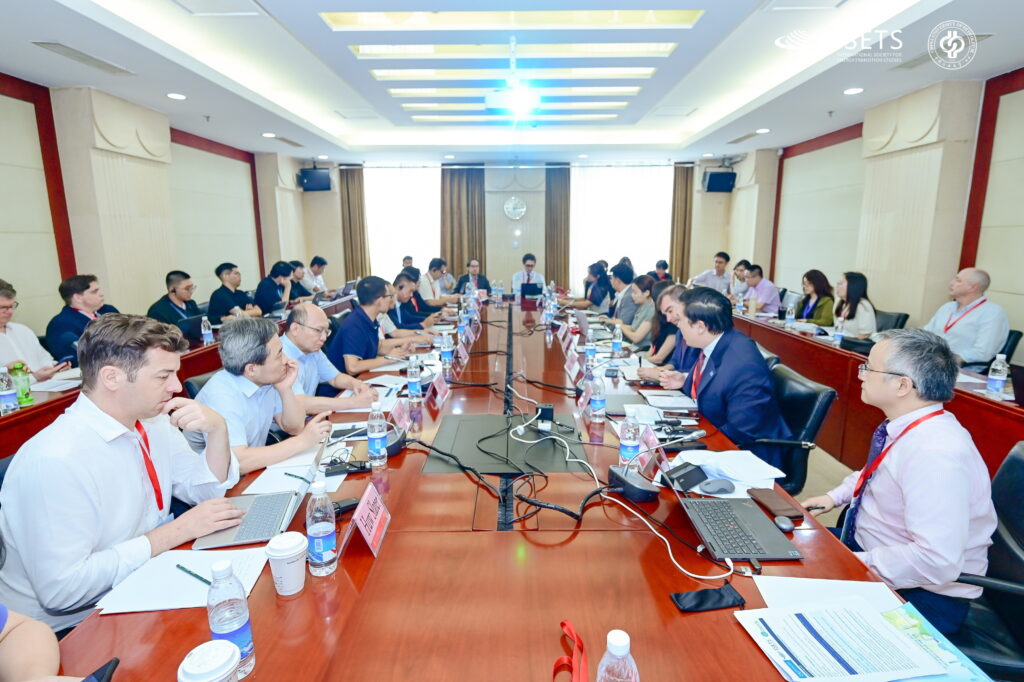
The United Nations Economic and Social Commission for Asia and the Pacific (ESCAP), the International Society for Energy Transition Studies (ISETS) and the Global Green Growth Institute (GGGI) jointly organised the ESCAP-ISETS-GGGI Joint Session on China’s Carbon Market Development and Regional Cooperation in Beijing on 23 August 2026. China’s Ministry of Foreign Affairs endorsed the event. The Institute for Energy Transition and Sustainability (IETS) and Wuhan University’s Institute of International Studies supported its delivery. The session formed part of the International Conference on Energy Transition and Sustainability 2026.
The dialogue brought together 42 registered participants from government agencies, carbon-market institutions, exchanges, regulated enterprises, universities, research organisations and international partners. Delegates from the Philippines and Thailand joined specialists from China, the Republic of Korea, Europe, Australia and the wider Asian carbon-market community.
A dialogue linking market design with implementation
The session examined how China’s national emissions trading system can move from administrative scale and high compliance towards a stronger and more predictable incentive for emissions reduction. It also gathered feedback for a joint policy brief and the wider Energy Transition for Green Growth and Prosperity carbon-finance diagnostic programme.
Opening remarks were delivered by Shize Lu of China’s Ministry of Ecology and Environment and Benjamin Rae of the United Nations Resident Coordinator’s Office in China. Professor Xunpeng Shi chaired the dialogue and presented the policy brief’s findings, while Stephen Tan of ESCAP introduced the regional programme and its work on carbon finance. Ramnath Iyer of the Institute for Energy Economics and Financial Analysis chaired the concluding roundtable.
China carbon market enters a new reform phase
Participants focused on the planned move towards absolute emissions caps from 2027, clearer cap trajectories, allocation reform, auctioning, treatment of accumulated surpluses and market-stability arrangements. The discussion found that the national market’s next test is whether these reforms create a credible and investable signal for low-carbon operations and technology.
Data quality and market infrastructure were central to the discussion. Reliable installation- and product-level emissions data, capable verification, consistent rules and timely disclosure are necessary before caps can be tightened. Speakers also examined the legal reliability of registry records, the separation of trading from registration and settlement, secure banking arrangements, cyber resilience, risk warnings and safeguards against settlement default.
China’s national market has expanded beyond power generation to include steel, cement and aluminium, bringing coverage to more than 3,700 entities. This expansion has required standardised digital onboarding, system upgrades for different industries and closer monitoring of compliance risk. Enterprise representatives also described the growing importance of carbon-data systems, centralised asset management, operational improvements and low-carbon investment planning.
Regional cooperation starts with practical foundations
Representatives from the Philippines and Thailand outlined their national progress and capacity needs. The discussion stressed that China’s experience offers useful sequencing and implementation lessons, but each country must adapt market design to its own legal framework, institutions, industrial structure and power system.
Participants identified compatible monitoring, reporting and verification principles, minimum registry data fields, unique unit identifiers, verifier training and Paris Agreement Article 6 readiness as practical areas for cooperation. Formal market linkage or credit fungibility was treated as a longer-term option that would require stronger political agreement and greater convergence in market maturity and ambition.
IETS supports continuing policy exchange
For IETS, the dialogue reflects its work to connect research with policy implementation and international cooperation. By supporting exchanges among regulators, market operators, enterprises and researchers, the Institute helps turn country experience into practical knowledge that can inform market development elsewhere in the region.
Follow-up will include finalising the ESCAP-ISETS-GGGI policy brief, continuing country diagnostics and preparing emissions-trading simulations, verifier training, study visits, system demonstrations and peer review of draft rules. Regional exchanges are expected to continue through 2027.
The session also supported regional cooperation on implementing the Paris Agreement and the Sustainable Development Goals.
* The substantive discussion was held under the Chatham House Rule. This article reports the main themes without attributing individual interventions.
Contributors

Xunpeng (Roc) Shi
Contributor
Topics: Carbon markets
Regions: China, Southeast Asia